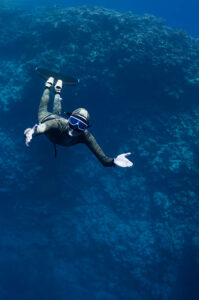
when you are scuba diving with a group, communication between you underwater is an important thing to practice for your safety. Diving hand signals are considered the best choice and really come in handy.
it is considered a second language for any diver which is similar to common gestures. In this article, we will introduce to you about 20 diving hand signals which are so easy to learn.
1)_ “Ok” Signal

The first diving hand signal to learn is the “ok” signal. Join your thumb and index fingers to form a circle and let the other fingers extend. this signal can used as a question and a response. That means if a diver asks another diver if he is okay or not, he must respond with either an “ok” signal or tell him that there is a problem.
Don’t confuse this ” ok ” hand signal and the thumb-up signal, as the second means underwater to end the dive.
2)_ ” Not Ok ” or ” Problem ” Signal
If you want to tell a buddy that there is a problem, you should flatten one of your hands and extend it while rotating it slowly from side to side, as you signal ” so-so” in a surface normal conversation.
the next step is to point to the source of the problem using your index finger. for example, if you faced the common equalization problem, after doing the ” problem ” signal, point with your index into your ear.
3)_ ” Ok” and ” Problem” signals on the surface
The importance of this sign is to tell your boat captain or the surface support staff that you face a problem while being on the surface of the water far away from the boat.
You can make this diving hand signal by joining both arms in a ring above your head. If you can’t move one of your hands, you shall use the other to make the signal by touching the top of your head by your fingertips.
In normal circumstances, don’t wave ” Hi ” to a dive boat while being on the surface, as the captain will directly think that you ask for help.
4)_ “End the Dive ” or ” Up ” Signal

The “Up” signal is a thumbs-up sign. It is considered one of the important diving hand signals, as by using it, any diver can end the diving trip immediately.
It is one of the demand response signals. You can’t be sure that the signal was understood until you receive the “Up” signal in return from the other diver.
5)_ “Down” Signal

It is similar to the thumbs-down sign. It means that you want to descend into the water. It is used as a first step to agree that you are prepared to begin diving.
6)_ “Slow down” Signal
It is considered from the basic signals that all beginners learn before going to scuba dive for the first time. Make this diving hand signal by holding out a flattened hand, then move it downwards. It is mostly used by instructors to tell enthusiastic beginners to swim slowly, as that not only makes diving more fun but also helps to avoid dangerous underwater behaviors such as hyperventilation.
7)_ “Stop” Signal


As a diver, you have two ways to say stop. The first method is commonly used in recreational diving. You can make it by holding up your flattened hand with your palm forward like a traffic cop.
The second method is preferred by tec divers and made by extending your fist with your palm-side facing outward. It is also called a “hold” signal and it is a demand-response signal, as once you make it, you should receive another in return, indicating that your buddy has understood and stopped or held their position.
8)_ “Look” signal
The “Look” diving hand signal is very simple. You can make it easily by pointing your index and third fingers at your eyes and then indicating the wanted observed object.
This signal is commonly used by scuba instructors during the open water course when they want the students to watch them while demonstrating an underwater skill. “Look at me” which is used by instructors is signated by making the “Look” signal, then pointing towards your chest with a finger.
9)_ “Come here” Signal
This signal is used every day by people in conversations. It is made by extending a flattened hand with the palm up, then bending the fingertips upward towards yourself.
10)_ “Level off” Signal
This “level off” diving hand signal is most commonly used to tell other divers that they have reached the maximum depth for that dive or to hold in that depth for a decompression stop.
Actually, it means maintaining this depth. You can make it by extending your flattened hand with your palm down and moving it slowly side to side horizontally.
12)_ ” Stay Together” Signal
Scuba diving instructors commonly use the ” stay together” signal to inform the divers to stay close to their diving buddies. You can signal it by placing your two index fingers together side by side.
It is also occasionally used by divers to reassign buddy teams. For example, when you have a low amount of oxygen and you are ready to ascend, you can use this sign to a diver who is in the same situation to ascend together.
13)_ “Safety Stop” Signal
This signal is used to make a safety stop which is minimally for 3 minutes. You can make it by holding a flattened hand (“level off” signal) over three raised fingers from the other hand.
14)_ “Decompression” or “Deco” Signal
This diving hand signal is made either by extending the pinkie or by extending the pinkie and the thumb (as a ”hang loose” sign). Tec divers use this signal to inform that they need a decompression stop.
Recreational divers should be aware of this signal, too, as it is useful if the diver exceeds the no-decompression limit for a dive and needs an emergency decompression stop.
15)_ “Low on Air” Signal
The “Low on Air” signal is an easy hand signal that is made by placing a closed fist against your chest. It is used to communicate that you have reached the predetermined tank pressure reserve for that dive.
Once your partner sees your signal, they should end the dive using the “up” signal and make a slow and controlled ascent to the surface.
16)_ “Out of Air” Signal
This diving hand signal is very important and all divers learn it during the open water and the experience courses to know how they act in this emergency situation.
This emergency can rarely happen when you make the proper pre-dive checks and follow the diving procedures. You can make the “out of Air” hand signal by moving a flattened hand across your throat in a slicing motion.
Your diving buddy should give you an immediate response and allow you to breathe from his alternative air-source regulator while ascending to the surface.
17)_ “I’m Cold” Signal
You can make the “I’m cold” diving hand signal by crossing your arms and rubbing your upper arms with your hands as you do when you try to warm yourself.
Contrary to what you think, this signal isn’t frivolous, as you become extremely chilled underwater, you can lose your reasoning and motor skills and your body will not be able to eliminate the absorbed nitrogen efficiently. So, once you feel chilled, make the “I’m cold” signal to inform your partner and end the dive immediately.
18)_ “Beak” or “Bubbles” Signal
This hand signal is used when you notice a leaking seal or bubbling piece of your gear or partner’s gear. On finding that, make the “Bubbles” signal by opening and closing your fingertips rapidly and end the dive immediately.
19)_ “Question” Signal
This hand signal is used in conjunction with one of the other diving hand signals. Made it by raising a crooked index finger. To understand, if you make the “Question” signal, then the “Up” signal, that means you ask “Should we go up?”.
20)_ “Write it Down” Signal
You can make the “write it down” signal by pantomiming that one of your hands is a writing surface and the other is writing with a pen.
This hand signal is used when all other communication fails. An existing of a writing device with you is a valuable tool underwater, as it can save your time and allow you to express complex ideas.